
Two panels, one round
Working an Aviator two bet strategy through all three outcomes
Aviator runs two independent bet panels in the same round, and splitting a stake between them turns one round into three possible outcomes instead of two. None of the three sits outside the published house edge.
An Aviator two bet strategy uses the game's two independent panels to place two different cash-out targets in a single round rather than one target across two separate rounds. That single change — one round, two tickets — is what turns a simple win-or-lose bet into three distinct outcomes, each with its own arithmetic and each worth pricing out on its own terms. Trying the two panels in fun mode first costs nothing and shows the layout before any of the arithmetic below is put to use.
The three outcomes of an Aviator two bet strategy
Set an early target on the first panel and a later, higher target on the second. From there, a round can end in exactly three places relative to those two targets. If the round crashes before the early target is reached, both panels lose their stakes and nothing is returned. If it crashes after the early target but before the later one, the first panel cashes out on time and the second panel loses. If the round reaches the later target too, both panels cash out and both stakes return a payout. There is no fourth state — once the two targets are fixed, every round sorts into one of those three, and each one has a clean dollar figure attached to it. That same arithmetic holds at any operator carrying the game, the wider set the the ranked list page actually compares.
Pricing the middle outcome
The middle outcome is the one worth sizing carefully, because the split can be made to break even there by arithmetic alone, without needing to know how often any of the three states actually happens. Put $5 on the early panel at a 1.20× target: if the round reaches that target, the panel returns $6.00. To make the middle outcome — early panel wins, later panel loses — net to exactly zero against the combined amount staked, the second panel needs $1.00 riding on it, because $5 × (1.20 − 1) = $1.00. With $5 on the first panel and $1 on the second, a middle-outcome round returns $6.00 against $6.00 staked in total: no gain and no loss, and the result falls out of the ratio between the target and the two stake sizes rather than from any guess about how the round will go.

Change either target and the ratio that breaks the middle outcome even changes along with it. A higher early target needs a larger second stake to reach the same breakeven point, because the payout multiple on the first panel is doing more of the work in getting back to the combined total; a lower early target needs less riding on the second panel to balance the same outcome.
What the other two outcomes pay
With the $5-and-$1 split above and a later target of 3.00× set on the second panel, a round that reaches both targets returns $6.00 from the first panel and $3.00 from the second, for $9.00 against $6.00 staked in total — a $3.00 gain on the round. A round that crashes before the early target returns nothing from either panel, a full $6.00 loss on the $6.00 staked. Set out together, this split produces a loss, a breakeven and a gain from the same pair of targets, depending only on where the round happens to end. Every dollar across all three outcomes is still governed by the same 97% return figure behind how the round and its return work, because that figure applies to the $6 of combined turnover regardless of how it is split between the two panels.
A second worked example, different targets
The same breakeven arithmetic holds at any pair of targets, not just the one above. Put $4 on the first panel at a 1.50× target: the breakeven stake for the second panel is $4 × (1.50 − 1) = $2, for $6 combined. A middle-outcome round — first panel wins, second loses — returns $6.00 from the first panel against $6.00 staked, breaking even exactly as before. Set the second panel's target at 2.50×: a round that reaches both targets returns $6.00 plus $2 × 2.50 = $5.00, for $11.00 against $6.00 staked, a $5.00 gain; a round that crashes before 1.50× returns nothing, a full $6.00 loss. Different targets change every dollar figure in the example, but the same structure — a loss, a breakeven and a gain — falls out of the same three-line calculation every time.
Why the split does not move the edge
Splitting $6 across two panels instead of staking the full $6 on one still puts $6 of turnover behind the round, and the house edge applies to that $6 exactly as it would to a single stake of the same size. What changes is the distribution of results across the three states above, not the average outcome across many rounds of playing it this way rather than another. The arithmetic that every Aviator strategy shares before it branches into a specific system covers that shared baseline in full; the two-bet split is one way of arranging a fixed amount of turnover within a single round, in the same family as a doubling ladder that arranges turnover across several rounds instead.
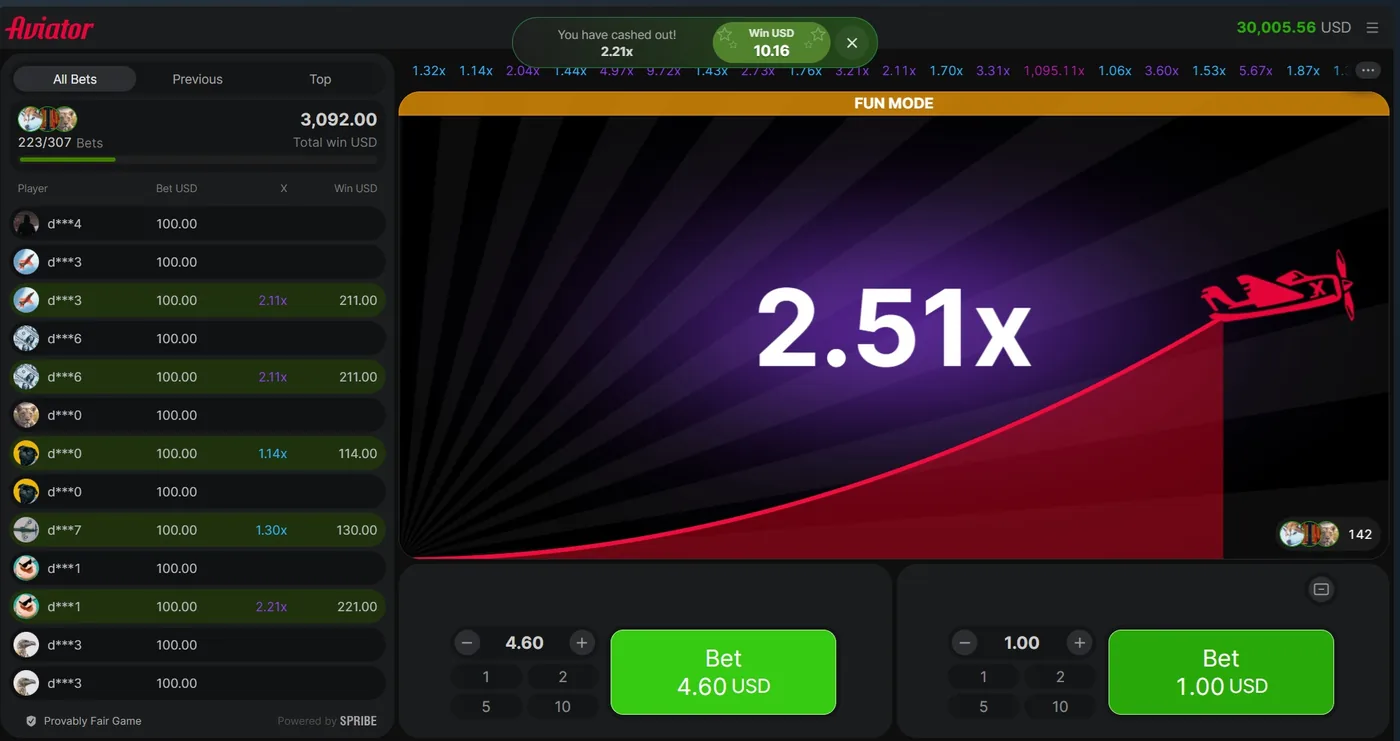
Setting up an Aviator two bet strategy before the round starts
Aviator's interface shows the two bet panels side by side, each with its own stake field, its own manual cash-out button and, where a player sets one, its own auto cash-out field. An Aviator two bet strategy is really just a decision about what goes into those two fields before betting closes — nothing about the panels changes once the round is under way, and neither stake can be adjusted after the bet window shuts. Choosing the two targets, and the ratio between the two stakes, is the entire decision; everything after that is the round playing out on its own.
Why the ratio matters more than the targets themselves
Picking two targets is the easy part of this system; the stake ratio between the two panels is what actually decides whether the middle outcome helps or hurts. A ratio set too low on the second panel leaves the middle outcome as a small loss rather than a breakeven; a ratio set too high turns it into a small gain at the cost of a larger loss if the round crashes early instead. The breakeven ratio worked out above is simply the midpoint between those two — not a target to aim for on its own, but a reference point for seeing which direction a chosen ratio leans.
Two panels versus two separate rounds
Splitting a stake across Aviator's two panels in one round is not the same exercise as staking twice across two separate rounds, because the two panels in a two-bet split share the same crash point — one round decides both outcomes at once, rather than two independent rounds each producing their own result. That shared crash point is what creates the clean three-outcome structure worked through above; two stakes placed across two separate rounds would instead produce four possible combinations of win and loss, priced out by an entirely different calculation.