
Reading the maths first
Aviator strategy explained through the arithmetic behind it
Every approach to Aviator, from a fixed cash-out target to a full staking plan, spends against the same 3% house edge. What changes is how that cost is spread across rounds, not the size of the cost itself.
An Aviator strategy only ever does one of two things: it moves a stake earlier or later in a round, or it splits a stake into a different shape. Neither move touches the number that decides the outcome over time — the 97% return Spribe publishes for the game, which leaves 3 cents of every dollar staked with the house across many rounds. A cash-out target, a staking ladder or a split bet all sit on top of that figure; none of them sit underneath it.
This page works through that arithmetic directly: what a target changes, what a staking pattern changes, and what neither one can touch. Two named systems, the doubling ladder and the two-bet split, get their own worked pages; here the maths sits at the level every approach to the game shares before it branches into either one.
What an Aviator strategy can actually change
Two players can stake the same total amount across a session and still finish with very different balances, because a cash-out target trades frequency for size. A low target is reached in more rounds than a high one, so it pays out more often and in smaller amounts; a high target is reached in fewer rounds and pays out rarely in larger amounts. Neither pattern is printed by the studio as a probability, so this page does not assign one — the point that matters is structural, not statistical: shifting the target moves money between “more, smaller” and “fewer, larger” without moving the long-run return figure itself. None of that arithmetic depends on which operator happens to be running the round, a comparison set out on the crypto casino aviator page.
The same logic applies to when a stake is placed and when it is pulled. How a round unfolds sets the bet window, the climb and the stop; a strategy can only choose where inside that sequence to act, not change what the sequence pays back on average.
The three cents that no target moves
Spribe's published return figure means that for every dollar staked across many rounds, 97 cents comes back to players on average and 3 cents stays with the house — see the full return and house edge workings for the source arithmetic. Put a number on it: stake $10 a round and the average cost per round is $0.30; stake that $10 fifty times, for $500 in total turnover, and the average cost across the session is $15. Raising or lowering the cash-out target changes which rounds pay and by how much; it does not change the $15.

That is the core fact an Aviator strategy has to work around rather than against. A target chosen to feel safer, or a stake chosen to feel exciting, still sits on top of the same 3-cent charge per dollar of turnover.
Staking patterns: same turnover, same cost
Flat staking — the same amount every round — and a scaling pattern that raises the stake after a loss both cost the house edge on whatever total gets staked, no more and no less. What a scaling pattern changes is the shape of the bankroll swing along the way: it can turn a short losing run into one larger stake rather than several small ones. The doubling ladder worked stake by stake shows exactly how fast that single stake grows and where a table or bet limit stops it. The two-bet split priced out shows the same accounting for a stake divided between two targets in one round rather than raised across several.
Neither page changes the answer given above: turnover sets the cost, and the house edge is fixed to that turnover regardless of how the stake is broken up.
Building a plan around a bankroll, not a target
A more useful way to plan a session is to start from an amount you are willing to see spent, then work out how many rounds that buys at a given stake. A $200 bankroll staked in $10 rounds buys twenty rounds — $200 in turnover — for an average session cost near $6. Doubling the stake to $20 halves the number of rounds the same bankroll covers and doubles the average cost to roughly $12 for the same $200 committed. The arithmetic scales in a straight line; nothing about a target or a pattern bends that line.

A casino's own bet ceiling or table limit is the practical stop on any plan built around raising stakes after a loss — the limit ends the plan before a losing run does, which is the exact mechanism the doubling-ladder page prices out in full.
Manual cash-out versus an auto cash-out field
Aviator offers both a manual cash-out button and an auto cash-out field that locks in a target before the round starts. The arithmetic behind either choice is identical, because the auto field does not change the return figure — it only removes the reaction time a manual cash-out depends on. A player relying on a manual click is exposed to whatever delay sits between deciding to leave and the click actually registering; an auto field removes that delay by acting at the exact multiplier set in advance, which is a difference in execution, not in the underlying cost per dollar staked.
That distinction matters most on a round that climbs quickly, where a manual reaction has less time to land before the stop. It does not matter at all to the session-level arithmetic worked out above: fifty rounds at $10 a round still average $15 in cost across the session regardless of whether every cash-out was manual, automatic, or a mix of both.
Sizing a bankroll for a losing run, not an average session
Session-level arithmetic like the $15 figure above describes an average outcome across many rounds, not what any single session actually delivers. A real session can run well above or well below that average, including stretches where several rounds in a row do not pay — a real possibility on any staking pattern, not a sign that anything about the game has changed. A plan built only around the average cost risks running out of bankroll during an ordinary losing stretch that the average simply smooths over across a longer run than any one session covers.
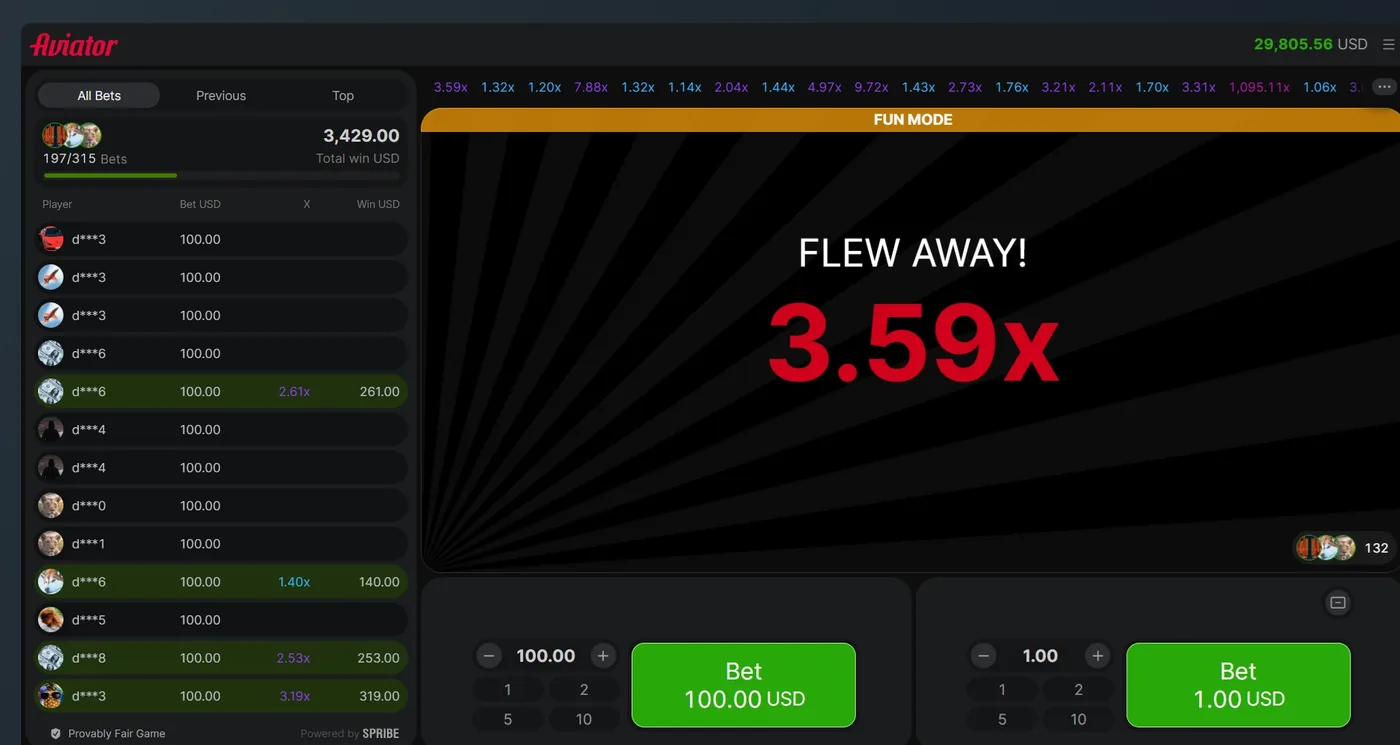
Planning around the bankroll figure from the previous section, rather than around how a single session is expected to go, is what actually absorbs that kind of stretch: a $200 bankroll staked in $10 rounds survives a run of losses the same way it survives a run of wins, because the number of rounds it buys does not depend on the order those rounds land in.
Two players, same total staked, different balances
Take two players who each commit $500 in turnover across a session — one staking $10 a round fifty times at a fixed 1.50× target, the other splitting stakes across a mix of targets round to round. Both sessions cost the same $15 on average, because the cost is set by the $500 in turnover, not by which target or mix of targets it moved through. What differs between the two players by the end of the session is how that $15 was distributed across individual rounds — smoothly in small amounts, or unevenly in a few larger swings — not whether one player found a cheaper way to play.
What sits outside an Aviator strategy
A strategy built on arithmetic is a different category from a claim to read the next round before it lands. Spribe's fairness scheme commits the round's result before any stake is placed, which is also why claims to predict a locked round do not belong on the same page as staking maths — one is arithmetic against a known figure, the other is a claim about information nobody holds.