
Free play, examined
The Aviator demo mode, and what it leaves out
Spribe's own game page carries a demo button, and fun-mode screens behave like the real thing in every visible way except one: nothing that happens to a play-money balance settles anywhere. This page covers what a demo does and does not tell you.
Aviator demo mode is the free-play version of the same game, reached through the “Play Demo” button on Spribe's own page. The climb keeps its usual pace, each round lasting roughly ten to thirty seconds, both bet panels stay active, and an automatic cash-out still fires at whatever multiplier is set. The one thing that changes is the balance attached to it: in demo mode that balance is not real, and nothing that happens to it settles anywhere once the session ends.
The game loads from Spribe’s own demo server on a play balance. Nothing is deposited and nothing can be withdrawn. 18+.
What a demo session is for
Free play exists to let a new player learn the screen before any money is involved — where the stake field sits, how an automatic cash-out is set, and how abruptly a round can end at 1.00× with nothing paid out at all. It answers questions about the interface, not questions about results: a session run on play money cannot say anything about how a funded account's balance is likely to move, because the two are drawing from the same underlying process rather than two different ones with different odds. Which operators actually put that same demo button in front of a real account is answered on the crypto casino aviator page rather than here.
What the Aviator demo screen shows
Fun-mode screenshots captured on 7 September 2026 carry three labels stamped across the frame — “FUN MODE”, “Provably Fair Game” and “Powered by SPRIBE” — confirming the session ran on play money rather than a funded account, while still running the studio's own engine underneath. The history strip fills in exactly the way it does in a funded session: one recorded round in that fun-mode play reached 1,095.11×, a figure the strip shows because that round happened, not because Spribe prints it anywhere as a ceiling. The round mechanics behind that number are the same whether or not money is attached.
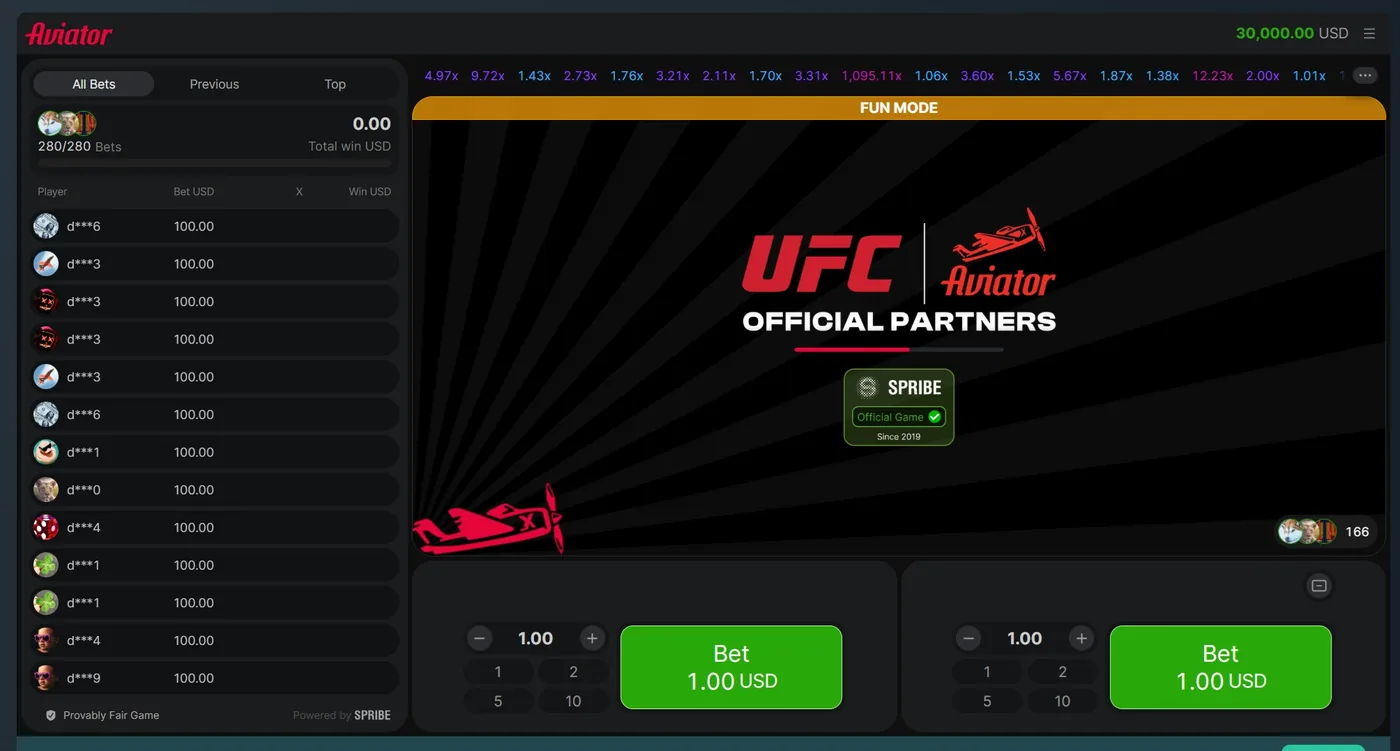
The rest of the screen carries over unchanged as well: both bet panels, the quick-stake shortcuts set to 1, 2, 5 and 10, and the counter showing how many players have joined the round in progress. A demo counter can read numbers just as high as a funded one, because the counter tracks participation in a shared round rather than the size of anyone's balance behind it. None of these on-screen details change between the two modes — only the balance sitting underneath the stake field does.
The Aviator demo engine and its seed check
Because the underlying engine is unchanged in demo mode, the same commit-and-reveal scheme described on the provably fair page governs a free-play round exactly as it governs a funded one — a server seed hash is published before betting opens either way. What a demo session cannot show is anything about Aviator's long-run return figure, because a handful of free rounds is nowhere near the number needed for a 97% average to become visible.
What a winning demo session does not prove
A short run of free rounds can finish well ahead of the long-run average purely by chance, the same way a short run of funded rounds can. A demo balance that climbs across a session says something about that particular sequence of stops, and nothing about how the next hundred rounds — demo or real — are going to behave. Treating a good demo run as evidence that a method works confuses a single short sample with the average it is meant to represent.
This cuts the other way too: a demo balance that falls across a session says just as little. Because both directions are equally possible over a short run, the outcome of any single demo session, good or bad, is closer to noise than to a verdict on how the game itself is built. The only way that noise settles down is a very large number of rounds, at which point the 97% figure starts to describe what is actually happening rather than one stretch of it.
Where demo mode fits before a deposit
Free play is useful for learning what the two bet panels do, how an automatic cash-out multiplier behaves once set, and how quickly a round can end at 1.00× with nothing paid out at all. It does not answer the questions that only come up once real money and an account are involved — deposit limits, identity checks tied to a withdrawal, or how a specific casino's terms are written. Free play and a funded account are the same engine wearing two different balances, not two different games.

A player moving from demo to a funded account is not moving to a different curve or a different fairness scheme — the seed check still applies the same way. What changes is everything sitting around the round: a deposit has to clear, coins have to be chosen, and a casino's own terms on identity and withdrawals start to matter in a way a play-money balance never triggers.
Reading a fun-mode label correctly
A “FUN MODE” stamp across a screen is not a warning that the game is simplified or that the round is somehow less real underneath it — it is simply a label attached to the balance type, present so a player always knows which kind of session they are looking at. The “Provably Fair Game” and “Powered by SPRIBE” labels sitting alongside it carry over from the funded version unchanged, because the underlying engine displaying them has not changed either. Reading past the labels to the mechanics they describe is the point of this page: the labels mark which balance is in play, not which rules apply to the round running underneath it.
What a demo cannot tell you about a specific casino
A demo runs on Spribe's own game page rather than inside any particular casino's account system, so it says nothing about how a specific operator handles deposits, identity checks or withdrawal caps once a session moves to real money. Two players could run identical demo sessions and then land on entirely different account terms once they deposit, because those terms come from the casino rather than from the game. Free play is a way to learn the round; it is not a preview of any operator's own rules.
That gap also applies to bonuses and to any wagering condition tied to them: a demo balance never touches a wagering requirement, because wagering requirements are written into a casino's own bonus terms and apply only once a real deposit and a real bonus are both in play. Learning the curve in demo mode does not shortcut any part of reading those terms once an account is funded.