
Studio reference sheet
Spribe Aviator: launch year, return figure and licensing reference
Spribe is the studio that built Aviator and released it in 2019; its own game page is the source for what the title actually publishes about itself. This page collects what is on record, and links to where each figure is covered in depth.
Spribe Aviator is the crash game that took the format from a handful of crypto-only sites into general casino lobbies, released by Spribe in 2019. What follows is a reference sheet built entirely from the studio's own published page: the figures it prints, the features it lists, and the ones it leaves blank.
Why a reference sheet, and why sourced only to Spribe
Casinos, ranking pages and guides describe Aviator in their own words, and those descriptions do not always agree with each other or with what the studio itself publishes. This page deliberately narrows the source to one place — Spribe's own game page and its own fairness page — so that every line here can be checked against the same material rather than against a secondhand summary of it. Where a figure is not on that page, the honest answer is that it is not stated, not a number borrowed from somewhere else to fill the gap. How this single studio's game turns up across a dozen separate operators is what the aviator crypto casino page works through next.
Spribe Aviator: what the studio's own page publishes
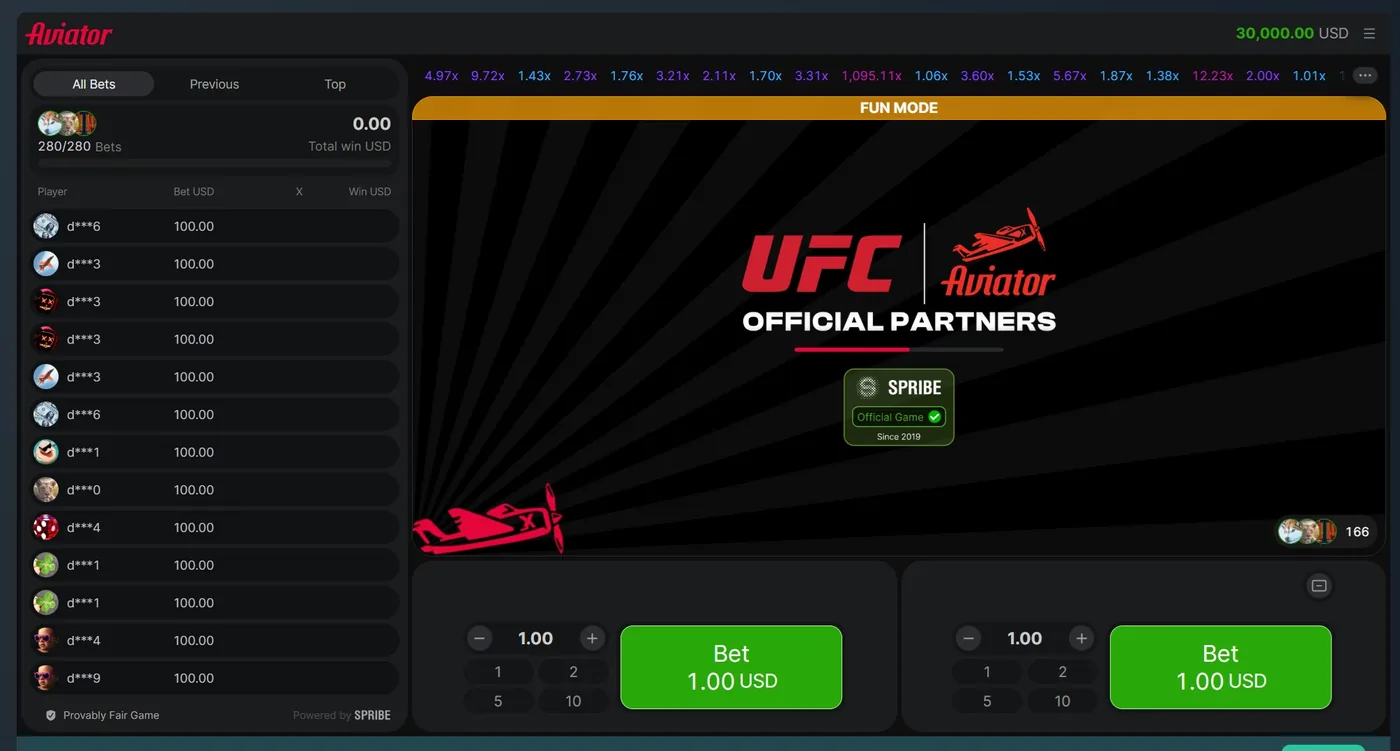
Spribe's game page lists Aviator's return at 97%, describes it as a “mini game” rather than a slot, and carries a “Play Demo” button linking to the free-play version covered on its own page. The lobby view includes an in-game chat alongside the round, and a feed of live bets and statistics running next to the curve rather than inside it. No top multiplier is printed anywhere on the page — a number that some outside lists supply on their own is not something Spribe's own material states, and this page does not either.

The “mini game” label is worth a note on its own. Spribe applies it to a family of titles built around a single repeating mechanic rather than a reel or a card, and Aviator is presented as one entry in that family rather than as a standalone product. That framing matters for how the game is categorised inside a lobby, even though it changes nothing about the round mechanics themselves.
The round Spribe Aviator publishes
The mechanics Spribe describes are the ones covered in full on how Aviator works: a multiplier climbing from 1.00× for a round lasting roughly ten to thirty seconds, two independent bet panels per round, and quick-stake buttons set to 1, 2, 5 and 10. The 97% return figure sits behind everything else on the page, and what that percentage means over a long run rather than a single session is worked through separately on the RTP page.
A players-in-round counter is also part of the published screen, tracking how many stakes have joined the round currently open rather than any tally of results. Three separate rounds read by the editors recorded 166, 142 and 173 players apiece — figures that describe participation at a point in time, not a leaderboard and not a feed of who cashed out ahead. Spribe's page pairs that counter with a live feed of bets and statistics rather than any list framed around winners.
Numbers Spribe attaches to specific recorded rounds
Two pieces of arithmetic from recorded fun-mode play illustrate how the published mechanics translate into a balance. In one round, a stake of 4.60 cashed out at 2.21× and 10.16 was credited — 10.166 rounded down, the fraction below a cent dropped, a single observation rather than a stated rounding rule. In another, a stake of 100.00 left the balance the instant the bet was placed, before the round went on to stop at 3.59×, illustrating that a stake is debited at the moment of the bet rather than at the moment the round ends.
The fairness scheme Spribe publishes
Spribe's fairness page lays out a commit-and-reveal scheme: a server seed made of sixteen random symbols is generated before a round, its SHA256 hash is shown to players in a settings panel before betting opens, and at the start of the round that seed is combined with every player's own client seed and hashed again with SHA512 to produce the result. Each round can be checked afterwards from the game's history through a dedicated icon, and a player can change their own client seed between rounds. The full mechanics of that check, and what it does and does not prove, are covered on the provably fair page.
Spribe's fairness page describes this scheme in general terms rather than as a step-by-step tutorial, leaving the walk-through of hashing, comparing and recomputing a round to sites that cover the mechanism in depth. What the studio's own page does commit to, in writing, is the sequence itself: seed first, hash published, betting opens, client seeds added, combination hashed, result derived — an order that does not change from round to round.
Where Spribe Aviator sits among the studio's titles
Spribe's published catalogue groups Aviator alongside other mini games built on the same kind of repeating round structure, though this reference sheet only carries facts that were confirmed directly on Spribe's own site rather than titles named without a supporting page open at the time of writing. Where another Spribe title is discussed elsewhere on this site, it is sourced the same way — to a page Spribe itself publishes, not to a secondhand list.
What is published and what is not
Spribe's page states the year Aviator launched, its return figure, and the features listed above; it does not print a maximum multiplier, a maximum win, or a top stake anywhere that this reference could find, and none of those fields are filled in with a figure invented to close the gap. Leaving a field blank here is a statement about the source, not an oversight in the writing: a number would be easy to add and impossible to attribute honestly, so the fields stay empty instead.
Spribe OÜ also carries account number 57302, tied to a licensing arrangement that this site's suspension page covers in full, including the dates and the ground given, rather than repeated here. That page exists separately from this reference sheet on purpose: this one is built from Spribe's own game and fairness pages, while the other draws from an outside public record — two different kinds of sources kept apart rather than folded into one page that blurs where each fact came from.
Reading this sheet alongside the rest of the site
Every other guide on this site takes Spribe's published facts as a starting point and builds outward — into arithmetic, into a fairness walk-through, into a comparison with other titles. This page stops at the starting point deliberately, holding the raw figures in one place so a reader who only wants the source material does not have to dig it out of a longer explanation elsewhere. Anyone who wants the fuller treatment of any single figure can follow the links placed next to it.
Treating this page as a source rather than as an argument is intentional. It makes no case for or against the game, offers no verdict on whether the return figure is generous, and draws no conclusion about the studio beyond restating what its own pages already say. The reasoning built on top of these figures — what 97% means in practice, what a hash check proves, what free play can and cannot show — lives on the pages this one links out to.
That separation of source from argument is worth stating plainly because it is easy for a reference sheet to drift into advocacy without anyone noticing, a sentence at a time. Every figure above traces back to a specific published page, and nothing above has been rounded up, filled in, or made to sound more definitive than the source material itself is.