
Inside a single round
How Aviator works, from the opening bet to the stop
Aviator runs on one repeating loop: a bet window, a climbing curve, and a stop nobody chooses in the moment. This page walks through what happens on screen and what decides it before you ever click a button.
Aviator is a crash game built by Spribe, first released in 2019, and every round it runs follows the same shape. A multiplier opens at 1.00× and rises for as long as that round lasts, typically somewhere between ten and thirty seconds, before halting at a point nobody chooses in real time. How Aviator works comes down to three moving parts: the bet placed before the climb starts, the number the curve is heading toward without announcing it, and the button pressed to lock in whatever the multiplier reads at that instant.
How Aviator works before you place a stake
Before a round opens, the outcome is already fixed. Spribe's own fairness page describes a server seed made of sixteen random symbols, generated before betting opens, and a hash of that seed is shown to the player under a “Provably Fair Settings” panel before a single bet is placed. Players supply their own client seed, and when the round starts the two are combined and hashed again. Nothing done during the bet window changes the number the curve is heading for — it changes only whether a stake is still on the table when the curve gets there, a process covered in detail on the provably fair page. Every operator scored on the aviator crypto casino page runs that same sequence underneath its own lobby.
The bet window itself is short, and both bet panels open and close together, closing again as soon as the curve begins its climb — which is why the quick-stake buttons exist at all. Reaching for a specific figure while a short window is closing costs time a player may not have, so buttons set to 1, 2, 5 and 10 let a stake jump straight to a preset amount. Missing the window entirely simply means sitting the round out; nothing is charged and nothing is risked until a stake is actually placed.
Aviator gives two independent panels rather than one, so a single round can carry two separate stakes with two separate exit points — one panel set to take a small multiplier quickly, the other left to run. A counter tracks how many players join a round before it closes: three separate rounds logged 166, 142 and 173 players each, a figure that describes participation, not results, and never a tally of who cashed out ahead.
Two panels, two decisions
Because the panels are independent, a player is not locked into one plan per round. One common pattern sets the first panel to auto cash-out at a low multiplier to bank a small return quickly, while the second panel is left to run further, either watched by hand or left on its own auto setting. Running two panels does not change the underlying seed combination behind the round — it only changes how a single stake is split across two separate exit points inside the same climb.
How Aviator works during the climb and the stop
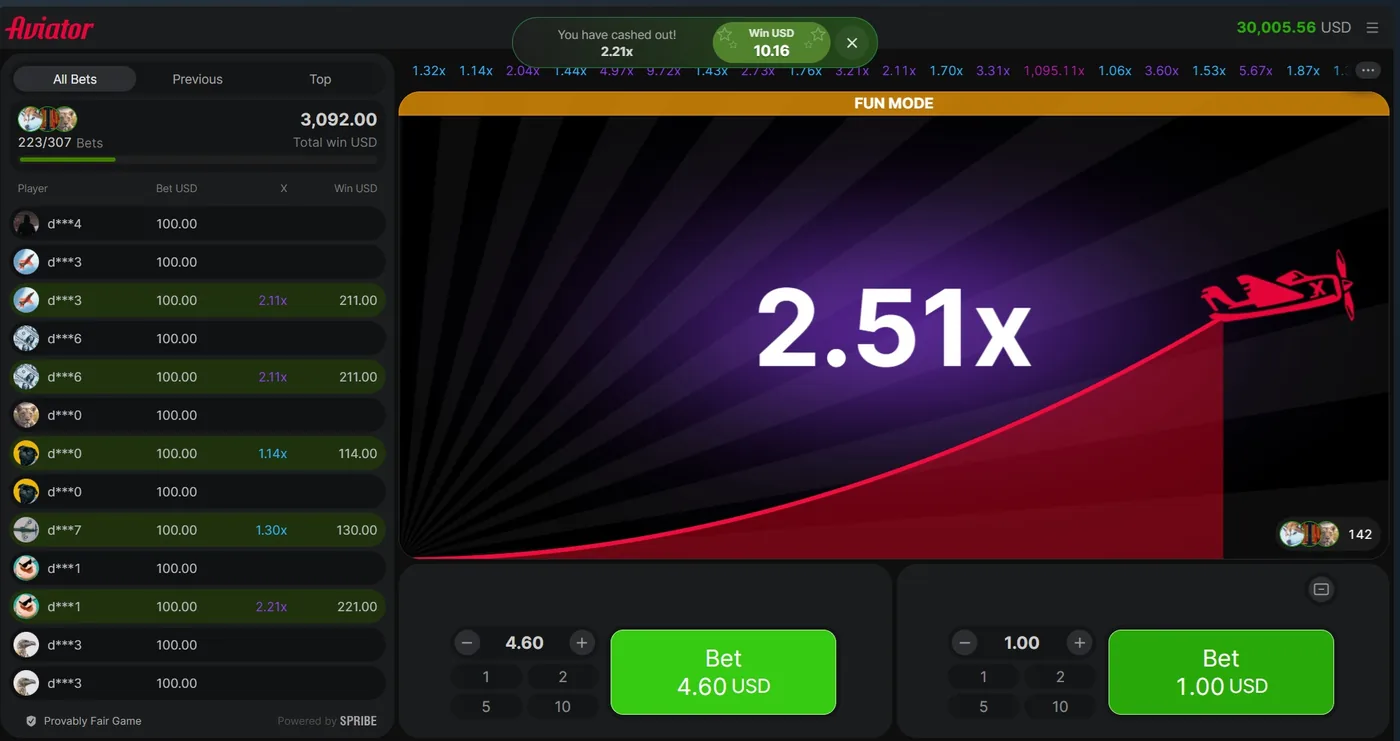
Once betting closes, the multiplier begins its ascent from 1.00×, rising without pause until an unannounced instant when it halts, and that stopping point was already decided by the seed combination described above — nothing about the curve's behaviour after that point is negotiable. Nothing displayed on screen before a round starts hints at where it is going to stop, because the number comes from a hash calculated the moment betting closes rather than a dial set in advance and simply hidden; watching the curve, the chat, or the count of players joining a round gives no information about the seed combination behind it.
A player who has staked can press cash out at any moment while the curve is still rising, and whatever the display reads at that instant is what the stake is multiplied by. Press too late, once the curve has already stopped, and the stake is lost outright.
The stake itself leaves the balance the moment a bet is placed, not when the round ends. In one round recorded by the editors, a balance of 100.00 was debited the instant the bet went in, and that particular round went on to stop at 3.59×. In another, a stake of 4.60 cashed out at 2.21× and 10.16 was credited to the balance — 10.166 rounded down, with the fraction below a cent dropped. Both are single recorded examples, not a rule for how every round behaves.
Auto cash-out and its limits
Aviator lets a player set an automatic cash-out multiplier in advance, so a panel exits on its own once the curve reaches that number, without needing a click at the right instant. It removes the risk of a slow reaction, but it does not change what the curve is going to do — a preset multiplier only fires if the curve gets that far before it stops. Set an automatic exit at 1.50× and it fires in almost every round, each time for a modest multiple; set it at 10.00× and most rounds stop well before it, leaving the panel with nothing that round. Both settings sit on the same underlying edge — a lower target trades size for frequency, not for a better result over time, an idea worked through with real dollar figures on the RTP page and in the strategy guide.
The history strip and what it leaves out
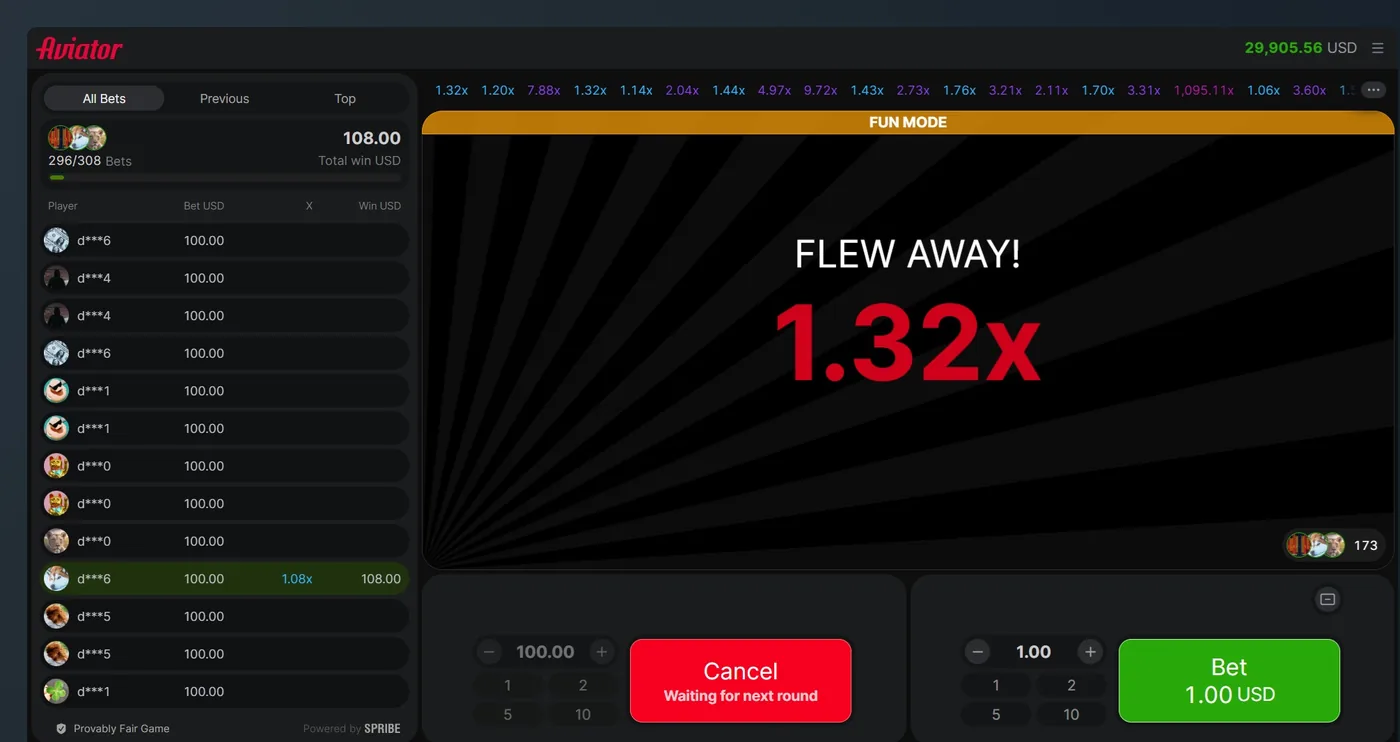
Every finished round is added to a history strip along the top of the screen, showing the multiplier it stopped at. The editors' own fun-mode play recorded a round of 1,095.11× in that strip on 7 September 2026 — a round that happened, not a ceiling Spribe prints anywhere, and not a promise about the next one. The strip is a record of what already ended, and nothing in it changes what a fresh seed combination decides for a round that has not started yet. Aviator also carries an in-game chat and a feed of live bets and statistics, features it shares with other crash games running alongside the round rather than inside it.
Reading the screen for the first time
A first look at Aviator can seem busy: the curve and its multiplier sit in the centre, the two bet panels sit beneath it with their own stake fields and cash-out buttons, quick-stake shortcuts run along each panel, and the history strip runs along the top showing recent stops. In-game chat and a feed of live bets and statistics sit off to the side, updating on their own timetable rather than the round's. None of those side elements changes the outcome of the round already in progress — they describe what other players are doing, not what a seed combination decided before betting even opened.

What stays the same whether or not money is involved
The curve, the bet window and the seed check behind them run identically whether a session is funded or not, which is why a demo round is useful for learning the screen before any deposit is made. What differs between a demo and a funded account has nothing to do with how the round plays out and everything to do with what an account requires before money moves — coin choices, minimums and identity checks that belong on other pages of this site rather than here.
Trying it before staking anything
Spribe's own game page carries a “Play Demo” button, and a free-play session behaves the same way a funded one does, curve and timing included, without money attached. What a demo session does and does not show is covered on the demo page, alongside a closer look at the studio behind the game.
A round ending at 1.00× — the curve stopping before it has risen at all — is built into the same mechanics as any other stop, not a separate malfunction case. The seed combination decides every stop the same way, and a stop at the very start of the climb is simply the outcome that particular combination produced. Nothing about a run of low stops in a row means the next round is due to run any longer, because each round's seed combination is generated fresh rather than carried over from the one before it.
None of this resembles a reel game, which is why calling it an aviator slot misleads in three specific places.