
Twelve terms, read end to end
Aviator crypto casino ranking: licences, ID rules and limits compared
Aviator runs inside dozens of crypto casino lobbies, but only some of their own terms hold up under the same five checks. This page ranks the ones that do, in order, with the clause behind every figure.

An animation, not a recorded round. Real Aviator rounds are random, and most end far below ×100.

Vave
150%
on your first deposit
Deposit from 20 USDT up to 120,000 USDT
18+ · ×35 wagering · full terms on the casino's site
Aviator by Spribe now sits inside dozens of crypto casino lobbies, and this aviator crypto casino ranking was built by testing every one of their own terms rather than by asking who claims the game loudest. Twelve operators cleared the bar that mattered: Aviator confirmed sitting in the lobby on 16 September 2026, and terms specific enough to score against five fixed questions.
The order below comes from those five questions, not from bonus size or game count. A crypto casino aviator search turns up plenty of names; this list only keeps the ones whose own documents printed an answer, cell by cell, with the clause attached to every figure.
| # | Casino | Checks passed | Licence | Coins | Identity check | Withdrawal cap | Visit Vave |
|---|---|---|---|---|---|---|---|
 Vave Latcas B.V. Vave Latcas B.V. | — | Curaçao · certificate lists vavegame.com register, 12 Sep 2026 | — | At withdrawal cl. 8.7 | No cap per period (cl. 8.8) | Visit the casino | |
| 1 |  Bitcasino.io Moon Technologies B.V. Bitcasino.io Moon Technologies B.V. | 4/5 | Curaçao · register: active register, 12 Sep 2026 | 12–13 on the list | On a trigger event cl. 3.13, 6.6 | Up to 1 million USDT a week (cl. 6.10) | Visit the casino |
| 2 |  Sportsbet.io MBet Solutions N.V. Sportsbet.io MBet Solutions N.V. | 4/5 | Curaçao · register: active register, 16 Sep 2026 | 5 named, list left open | At withdrawal cl. 6.5, 6.6 | — | Visit the casino |
| 3 |  Winz.io Novatrix SRL Winz.io Novatrix SRL | 4/5 | Anjouan and Tobique register, 24 Aug 2027 | 12 on the list | At withdrawal cl. 8.4, 11.10 | 100,000 USDT a week · 400,000 USDT a month (cl. 11.7) | Visit the casino |
| 4 | Blockbet | 4/5 | Anjouan · valid until 13 March 2027 register, 16 Sep 2026 | — | At withdrawal cl. 8.3; KYC Policy | €10,000 a month; €5,000 when the balance is ten times the deposits (cl. 8.6) | Visit the casino |
| 5 |  Metaspins Metaspins N.V. Metaspins Metaspins N.V. | 3/5 | Anjouan in the terms, Curaçao in the register register, 12 Sep 2026 | — | On a trigger event cl. 9.7 | No upper cap; large sums in instalments (cl. 12.5) | Visit the casino |
| 6 | TG.Casino Gaming Services Provider N.V. | 3/5 | No licence number published register, 16 Sep 2026 | — | At withdrawal cl. 9.3 | €150,000 per rolling 30 days (cl. 9.6) | Visit the casino |
| 7 | Winna | 3/5 | Tobique · holder list without domains register, 8 May 2027 | 10 named, list left open | On a trigger event cl. 6.1, 6.2, 8.5 | US$10,000 per 24 hours (cl. 8.7) | Visit the casino |
| 8 | Hyper Lucky | 3/5 | Anjouan · expiry date passed register, 28 Aug 2026 | — | On a trigger event cl. 10.3, 8.13 | — | Visit the casino |
| 9 |  Bitsler Oyine N.V. Bitsler Oyine N.V. | 2/5 | Curaçao · register: active register, 12 Sep 2026 | — | On a trigger event cl. 8.22, 4.3 | Operator sets the minimum and maximum (cl. 8.6) | Visit the casino |
| 10 |  BetFury Games B.V. BetFury Games B.V. | 2/5 | Curaçao · register: active register, 16 Sep 2026 | 11 named, list left open | Moment not stated cl. 5.2, 17.2 | Wins of US$50,000 or more may be paid in parts (cl. 9.6) | Visit the casino |
| 11 |  WinDice Windice Group Limited WinDice Windice Group Limited | 2/5 | Anjouan · valid until 3 November 2026 register, 16 Sep 2026 | — | Moment not stated cl. 15.1 | — | Visit the casino |
| 12 |  Wolfbet Wolfbet | 1/5 | Anjouan · number in the terms register | 32 on the list | Moment not stated cl. 5 ¶1 | US$8,000 a week · US$30,000 a calendar month cl. 15 ¶5 | Visit the casino |
Every button in this table opens the same place: the casino this site is paid to feature, and not the operator printed in the row beside it. The checks passed beside each name are counted from published terms and register entries, and that count is not for sale.
Also named on published Aviator casino lists, outside the five-check score
 BC.Game
 Shuffle
 Bet Panda
 Rainbet
- Acebet
- Thrill
 Duelbits
- JustCasino.io
- Duel
- Razed.com
- Metawin
- Goated
- Chips.gg
 Bitstarz
- Whale.io
- Bets.io
- Yeet
 CoinCasino
How this aviator crypto casino ranking works
Five questions decide the order below, all aimed at the same document: an operator's own terms, not a marketing page. First, is an identity-check clause printed at all. Second, does that clause name the moment the check begins — at sign-up, on a trigger event, or only once a withdrawal is requested. Third, is a sum actually written into the clause, rather than left to discretion. Fourth, do the terms set a deadline for sending documents once they are asked for. Fifth, does the licence printed in the terms or the footer actually turn up in the issuing authority's own register, listed under the casino's own domain rather than one that merely resembles it.
A casino only earns a place in this aviator crypto casino ranking once Aviator itself was seen sitting in its own lobby or on its own game page — checked on 16 September 2026 — and its terms could be scored against all five questions above. Someone running a crypto casino aviator search will find plenty of names that never reached that bar; a fuller walk-through of what counts as evidence, and what does not, sits on the methodology page, and what the ranking does and does not assert on conditions of use. There is no automatic best aviator crypto casino among the twelve that follow — only a highest point total, which is a narrower claim. That same discipline separates a fully scored entry from a name simply repeated across other lists without its terms ever being read.
The ranked aviator crypto casino list
Twelve operators cleared both bars — Aviator confirmed live, terms specific enough to score — and the order below runs strictly by points, highest first.
1. Bitcasino.io
Bitcasino.io tops this aviator crypto casino list with a full match on four of the five questions. Aviator is in its lobby, filed under Spribe on its own providers page. The identity clause fires on a trigger event and prints a figure — €2,500 or its value in coins (cl. 6.6) — though the terms set no deadline for sending documents once that trigger is hit. The Curaçao register lists OGL/2023/111/0069 under Moon Technologies B.V. with bitcasino.io among its domains, checked 12 September 2026. Withdrawals run up to 1 million USDT a week (cl. 6.10), and the coin list runs to twelve or thirteen entries. It suits someone who wants a confirmed register match and a wide coin list, and can live without a printed deadline for documents.
2. Sportsbet.io
Sportsbet.io shares Bitcasino.io's four-question score, and its Aviator entry sits in the casino section under Spribe. The same €2,500 threshold appears here too (cl. 6.6), triggered at withdrawal rather than at an earlier named moment, and the general terms set no deadline for documents once that threshold is crossed. Its Curaçao licence, OGL/2023/110/0072, is held by MBet Solutions N.V. and matched sportsbet.io in the register on 16 September 2026; clause 1.2 of its own terms prints the same number. No withdrawal cap turned up in the general terms, and the coin list names five — BTC, ETH, USDT, LTC and XRP — without saying the list stops there. It suits a crypto casino aviator player already using the sportsbook who wants the same register-matched licence to cover Aviator too.
3. Winz.io
Winz.io scores four points from a different pair of gaps: no amount is printed for its identity clause, but a deadline is — two weeks from the date documents are requested (cl. 8.4, 9.4). Aviator has its own dedicated game page here. Where the licence sits is less settled: the terms (cl. 1.1) cite a Tobique number for Novatrix SRL, while the Anjouan register, opened 16 September 2026, lists winz.io under the same company with a different number, ALSI-202508056-FI2, valid to 24 August 2027 — two authorities, neither reconciled with the other by this site. Withdrawals cap at 100,000 USDT a week and 400,000 USDT a month (cl. 11.7), and twelve coins are named (cl. 4.1). It suits someone who wants a stated document deadline more than a single settled authority. As an aviator crypto casino option, it is the only one of the twelve pairing a printed deadline with two unreconciled licensing authorities at once.
4. Blockbet
Blockbet matches Bitcasino.io's pattern: an identity clause with a printed sum but no deadline. Aviator's own play page names Spribe directly, printing a 97% return and a 3% house edge on the same screen. The threshold here is a lifetime figure rather than a single-withdrawal one — €5,000 in aggregate deposits, per its KYC Policy — checked at withdrawal under clause 8.3. Its Anjouan licence, ALSI-202603013-FI1, held by 3-102-953229 SRL, matched blockbet.gg in the register on 16 September 2026 and runs to 13 March 2027. Withdrawals cap at €10,000 a month, tightening to €5,000 once a balance reaches ten times total deposits (cl. 8.6). It suits someone comfortable with a lifetime deposit trigger rather than a per-transaction one. Among crypto casino aviator entries with a lifetime threshold rather than a per-withdrawal one, this is currently the only example on the list.
5. Metaspins
Metaspins scores three points, split between a stated deadline and a licence that does not match its own domain in the register. Its home page describes Aviator directly: “Aviator is produced by Spribe, the provider behind many top games.” The identity clause activates on a trigger event (cl. 9.7) without printing a sum, but a thirty-day deadline for documents is set elsewhere in the terms (cl. 9.10). Its own terms cite an Anjouan number, ALSI-202606048-FI2 (cl. 1.1), while the Curaçao register lists Metaspins N.V. holding OGL/2024/1063/0437 as active for metaspins.com — two authorities this site does not choose between. No upper withdrawal cap is printed; large sums move in instalments instead (cl. 12.5). It suits someone who wants a document deadline more than a single confirmed authority. As an aviator game crypto option it is one of only two on the list to print an actual document deadline at all.
6. TG.Casino
TG.Casino scores three points with the same amount-but-no-deadline shape as Bitcasino.io, except its own domain never turns up in a register at all. Its dedicated Aviator page names Spribe by title. The identity clause prints two figures rather than one: €2,000 deposited triggers the second step of its AML Policy, and US$5,000 marks the third, both without a stated deadline for sending documents. Clause 22.6 of its own terms sends complaints to Gaming Services Provider N.V. without printing a licence number anywhere, and a Curaçao register lookup for tg.casino, run on 16 September 2026, returned no entry under that domain. Withdrawals cap at €150,000 per rolling 30 days (cl. 9.6). It suits a crypto casino aviator player who accepts that no register entry under this domain was found at all.
7. Winna
Winna also scores three points on the amount-printed, no-deadline pattern. Its help centre carries a page built around Spribe titles including Aviator. The identity clause triggers on more than one event (cl. 6.1, 6.2, 8.5) and prints €2,000 or its coin equivalent (cl. 8.5), but no deadline follows once that figure is crossed. Its terms name GG Gaming S.R. L. under the Tobique authority without a licence number; the Tobique holder list, opened 16 September 2026, shows that company as a registered holder to 8 May 2027, but the list itself carries no domain column, so winna.com cannot be matched against it either way. Withdrawals cap at US$10,000 a day (cl. 8.7), and ten coins are named without the list being closed. It suits someone who wants a printed threshold over a confirmed domain match. Judged purely as an aviator crypto casino for identity-threshold clarity, it prints a sum where several others on this list do not.
8. Hyper Lucky
Hyper Lucky rounds out the three-point group the same way, and Aviator sits in its lobby under the Spribe heading. The identity clause triggers on a listed event (cl. 10.3, 8.13) and prints €2,000 or its coin equivalent (cl. 8.13), with no deadline for documents once that figure is reached. Its terms name BrightSky Ltd and licence ALSI-202508057-FI2; the Anjouan register, opened 16 September 2026, does list hyperlucky.com under that same holder and number — but the register's own expiry date for that entry is 28 August 2026, a date that has already passed, even though the entry still displays as valid. No withdrawal cap or coin list was found. It suits someone willing to check that expiry date for themselves rather than take the listing at face value. Anyone treating this as a crypto casino aviator shortlist entry should weigh that passed expiry date before anything else printed about it.
9. Bitsler
Bitsler drops to two points once the moment of the identity check goes unstated. Its own casino page markets Aviator directly by name under Spribe. The clause requires identity documents (cl. 8.22, 4.3) without saying when that requirement starts and without printing a sum, so the deadline question does not apply either. Its Curaçao licence, OGL/2024/930/0387, is held by Oyine N.V. and matched bitsler.com in the register on 12 September 2026, even though its own terms still describe that licence as an application rather than a granted one. Withdrawal limits are left to the operator to set case by case (cl. 8.6), and no coin list was found. It suits someone who wants a confirmed register match over a stated identity-check amount. An aviator game crypto search that stops at the register match alone would miss that this same clause names no sum.
10. BetFury
BetFury also scores two points, and its Spribe review page names Aviator directly. Its identity clause never states when the check begins (cl. 5.2, 17.2), and no sum is printed either. Clause 17.2 itself is worth reading carefully: it sets a seven-day first response and a thirty-day outer limit for BetFury's own compliance procedure — the company's own review window, not a deadline handed to a player for sending documents. Its Curaçao licence, OGL/2024/1494/0942, is held by Universe B Games B.V. and matched betfury.io in the register on 16 September 2026. Wins of US$50,000 or more may be paid in parts (cl. 9.6), and eleven coins are named without the list being closed. It suits someone who reads clause 17.2 as the company's own timetable, not theirs. Among aviator crypto casino entries with a confirmed Curaçao match, this is the one where that clause most needs a careful read before it is mistaken for something else. A crypto casino aviator write-up that skipped clause 17.2 entirely would miss the one detail that matters most about this particular entry.
11. WinDice
WinDice matches BetFury's two points, and Aviator's own thumbnail appears in its crash category. The identity clause requires documents (cl. 15.1) without naming when that requirement starts or printing a sum, so no deadline applies either. Its Anjouan licence, ALSI-202411018-FI1, held by Windice Group Limited, matched windice.io in the register on 16 September 2026 and runs to 3 November 2026. No withdrawal cap or coin list turned up in what this site could read. It suits someone who wants a currently valid register entry without a stated identity-check amount attached. As a crypto casino aviator option it offers that valid entry with little else printed on the identity question.
12. Wolfbet
Wolfbet closes the ranked list with a single point — an identity clause exists (cl. 5 ¶1) but names no moment, no sum and no deadline, and its own domain does not turn up matched in the register the way the higher-scoring names above do. Aviator sits under its Spribe selection. Its terms print an Anjouan number, ALSI-132405048-FI3, in the footer and in clause 1 ¶1, though this site's own register check could not confirm wolfbet.com against it directly. Withdrawals cap at US$8,000 a week and US$30,000 a calendar month (cl. 15 ¶5), and its coin list runs to thirty-two entries, the widest of the twelve. It suits someone who wants the widest coin choice on this crypto casino aviator list and can accept the weakest score on the licence question.
Further down the same list, more names stand without a score at all — casinos other lists name for Aviator but whose own terms this site either could not match against all five questions, or where Aviator itself was not confirmed sitting in the lobby.
Aviator: the round, the return and the two panels
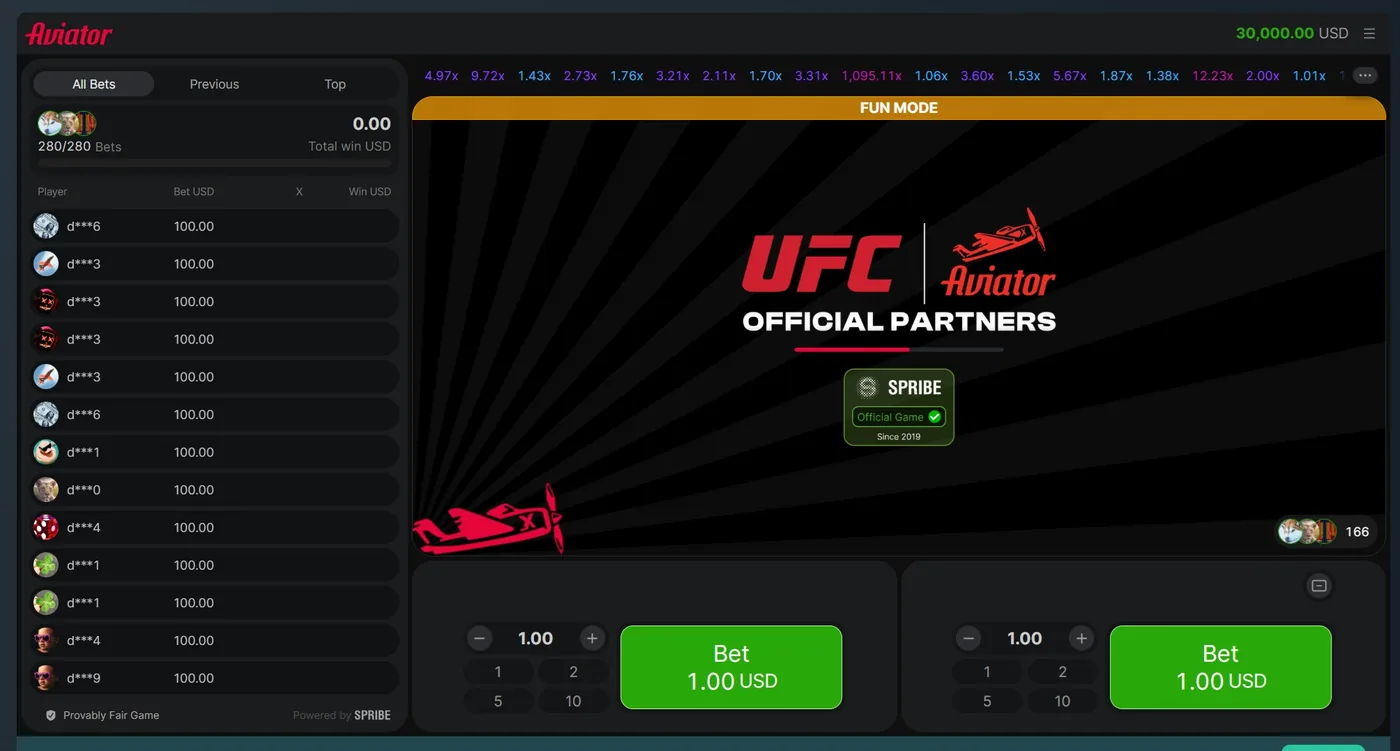
Every one of these twelve casinos runs the same game underneath its own lobby skin. Spribe's own page for Aviator states a 97% return, no top multiplier printed anywhere on it, and a Play Demo button sitting next to the real-money one. A round opens a short bet window, both panels closing together the instant the climb begins, and quick-stake buttons set to 1, 2, 5 and 10 exist because that window rarely stays open long. Three separate rounds logged 166, 142 and 173 players joining before the window shut — a participation count, not a leaderboard of winners. That same screen is what an aviator game crypto search is usually looking for in the first place: the round itself, rather than any one casino's branding around it.
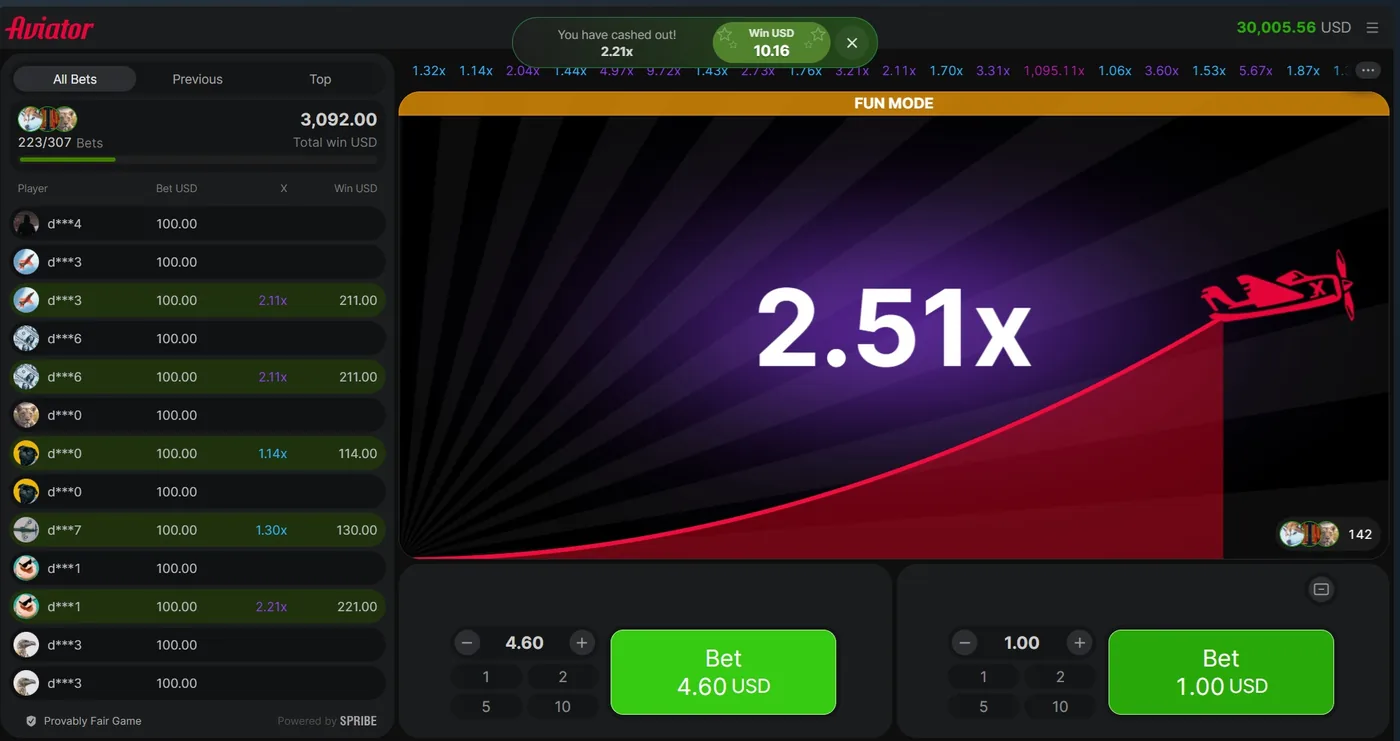
Two independent panels mean two separate stakes and two separate exits inside a single round, one set to bank a small multiplier quickly while the other runs further, either by hand or on its own auto cash-out setting. Auto cash-out only fires if the curve reaches the chosen number before it stops — a low target fires in most rounds for a small return, a high one rarely fires at all. The editors' own fun-mode screens, taken 7 September 2026, showed a round settle at 1,095.11× in the history strip — a round that happened once, not a ceiling Spribe prints anywhere. In a separate round a stake of 4.60 cashed out at 2.21× for 10.166, credited as 10.16 with the fraction below a cent dropped; a different bet of 100.00 left the balance the instant it was placed, and that round went on to stop at 3.59×.
None of that changes depending on which aviator crypto casino lobby happens to host the game, since the round itself runs on Spribe's own servers rather than an operator's. A full walk-through of how a single round unfolds, from the opening bet to the stop, sits on a page built around exactly that.
Provably fair, in brief
Spribe commits to a round's outcome before a single bet is placed: a server seed is generated, its hash for the coming round shown to players in a settings panel, and player-supplied client seeds are combined with it and hashed again once betting closes. Nothing about that process can be adjusted after the fact, and every finished round can be rechecked from the game's own history using its provably fair icon. What this proves is narrower than it sounds — it shows a round was not changed after bets went in; it says nothing about how likely any particular stop is, or about a casino's own payout behaviour once a win is cashed out. The same seed scheme runs identically inside every aviator crypto casino on this list, Vave's own fun-mode lobby included. A closer look at what the seed check actually proves covers both sides of that line.
Paying an aviator crypto casino in crypto
Coins move differently from cards: a deposit needs the right network chosen before it is sent, confirmations before it counts as cleared, and once it leaves a wallet, nothing about that transfer can be called back. Minimums vary by operator and by coin — Winz.io lists twelve coins under clause 4.1, Wolfbet's list runs to thirty-two, and Sportsbet.io names five without closing the list — and a transfer sent below a printed minimum risks being lost outright rather than credited. Stakes on Aviator itself can usually be read in coin units or converted to a fiat display, though the balance underneath still moves with whatever the coin is doing on the wider market, independent of anything happening in a single round. Reading a crypto casino aviator lobby this way, coin first rather than fiat first, is the more accurate view of what a stake is actually worth.
A crypto casino aviator deposit and a card deposit end up funding the same lobby; only the steps in between differ. Balances read that way still swing with the market: a crypto casino aviator session funded in a volatile coin can show a different fiat value at cash-out than it did at deposit, independent of anything the round itself did. An aviator game crypto deposit sent to the wrong network address is not recoverable by the operator either, which is why the minimum and the network shown on each casino's own deposit screen are worth reading before a transfer, not after. The mechanics of a coin deposit specifically, address to confirmation, are covered on the bitcoin-focused page.
Identity checks and withdrawals
The five-question ranking above is really asking one thing from four different angles: what does a casino's own terms actually commit to before a win becomes coins in a wallet. Thresholds vary from €2,000 to €5,000 depending on the operator and whether the figure is per-withdrawal or a lifetime deposit total; only two of the twelve — Winz.io and Metaspins — print an actual deadline for sending documents once they are requested, and even those two differ, at two weeks and thirty days. Caps run from four figures a day to seven figures a week, and a handful of operators reserve the right to pay a large win in instalments rather than as one transfer.
Two real-money records sit behind those clauses rather than in front of them. Withdrawing from Vave on 28 August 2026, the editors moved roughly 5,000 USDT in total out without facing a single identity check along the way — a single account over a single stretch, worth reading as one data point rather than a promise, given that clause 8.7 still leaves Vave free to ask for identity documents ahead of any payout. A separate TrustDice record from May 2026 tells a different story: sums cleared with no verification step at all until the running balance crossed about US$5,000, at which point the account was flagged for review, a compliance message followed with a link to Veriff, one submitted driving licence came back rejected, and a passport succeeded only on try number five. Reading those clauses before depositing is the one habit that separates a careful crypto casino aviator player from one relying on a bonus banner alone. Full detail on caps, thresholds and deadlines by clause sits on the withdrawal page.
Bonuses and wagering on Aviator
Bonus terms sit apart from the identity-and-withdrawal clauses above, and only one of the terms read for this crypto casino aviator ranking names a deposit-wagering figure that applies before a bonus balance becomes withdrawable. Vave's own terms (cl. 8.11) set that figure directly: a deposit needs to be wagered three times through casino or live games, or once through the sportsbook, before a withdrawal against it can be made. None of the twelve ranked casinos here published a rule naming Aviator, or crash games generally, at a different wagering weight from the rest of the lobby — where a term did not say so, this page does not assume one. Wagering figures like Vave's sit outside the five-question score, though they still shape what a crypto casino aviator balance is actually worth once a bonus is attached to it. A closer look at wagering rules, deposit terms and what they mean for a crash-game balance specifically sits on the bonus page.
Trying the demo first
Spribe's own game page carries a Play Demo button next to the real-money one, and free play runs the identical curve, timing and seed commitment as a funded session — the only thing missing is money attached to the stake. It is a reasonable way to read the screen, the two panels and the history strip before any coin deposit is made anywhere on this crypto casino aviator list. Most aviator game crypto searches land on this same demo button sooner or later, before a single coin ever moves. What a demo session does and does not show, compared with playing on a funded balance, is covered in full on the demo page.

Claims of forecasting a round
Search results around Aviator carry no shortage of apps, channels and pages that claim they can tell a player where a round is going to stop before it happens. That claim runs directly against how Spribe's own seed scheme works: the server seed for a coming round is generated and hashed before a single bet opens, and nothing that happens during the betting window changes the number that hash is already tied to. Outside services reading chat activity, past stops in the history strip, or anything else visible on screen have no access to that seed and cannot know what it resolves to. No aviator crypto casino publishes a seed early, to anyone, at any price, which is exactly what makes an outside forecasting claim impossible to keep regardless of how it is marketed. This site takes apart what is actually being sold under those claims, in more detail, starting with why a round's stop resists exactly that kind of forecasting.
Playing within limits
Nothing on this page changes the arithmetic behind Aviator or any other crash game: the house edge sits in the seed mapping itself, not in a strategy or a stake pattern layered on top of it. Setting a deposit limit, a loss limit or a time limit before playing, and keeping to it regardless of how a session is going, is the one control that stays entirely in a player's hands. That control applies the same way on every aviator crypto casino in this list, regardless of its score on the five questions above. Gamblers Anonymous offers support for anyone who feels their own play has moved past that control, at any hour, without needing a local office nearby.
Playing on a phone needs no download at all, and the app people search for was never published.
Who reads the documents behind each of these figures is set out on the authors page.
Which coins a cashier actually takes is published by only four of the twenty, a gap worked through on the Ripple page.